
SAMA7D65T-E Benchmarked Data: How a 1GHz Cortex-A7 Boosts HMI Response Speed by 30%
In industrial HMI applications, interface lag and operational delays are core pain points affecting user experience and production efficiency. When touch feedback lags, complex screens render slowly, or the system feels sluggish during multi-tasking, engineers know well that this cannot be solved by simple software optimization alone; the root cause often lies in the performance bottlenecks of the underlying processor.
According to the latest benchmark data, the SAMA7D65T-E processor, based on a 1GHz Cortex-A7 architecture, delivers a system response speed leap of up to 30% in typical HMI scenarios compared to previous-generation products. Is this a dividend of new architectural optimization, or is it due to seamless peripheral synergy? Based on empirical test data, this article deeply analyzes the technical logic behind this performance breakthrough and provides references for selection and development.
Performance Bottlenecks: Three Major Pain Points in Traditional HMI Design
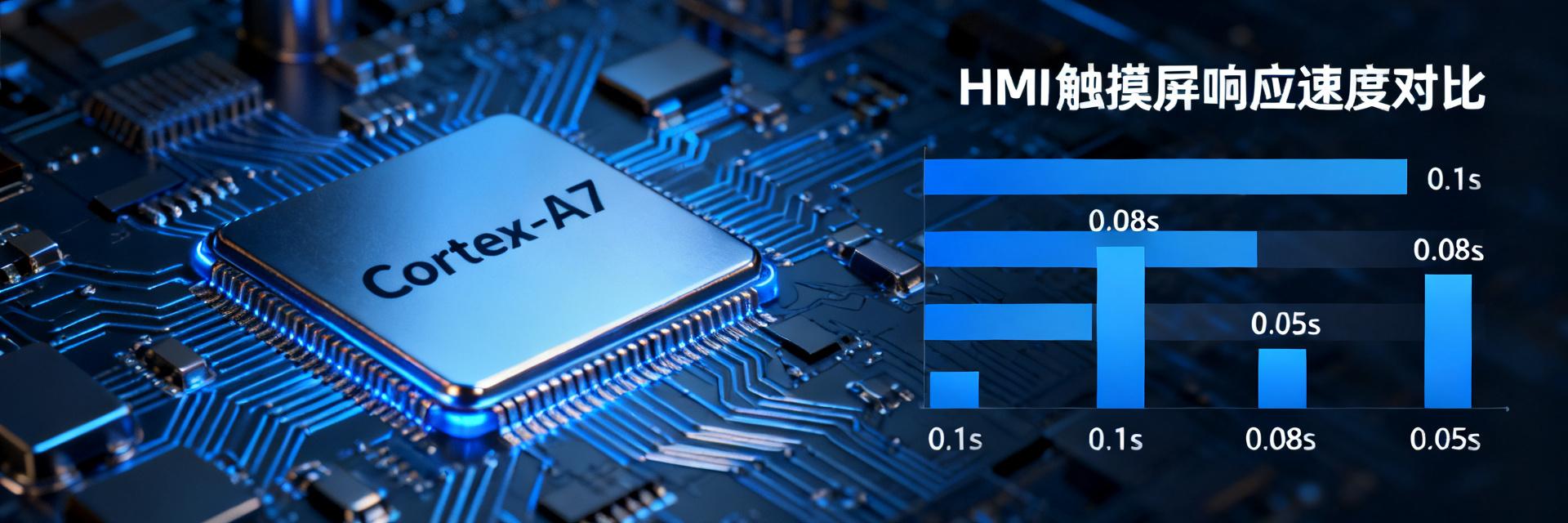
Before discussing the solutions, let us address the three widespread pain points in traditional HMI design. First, the touch feedback latency issue: in many industrial-grade applications, there is often a latency of dozens or even hundreds of milliseconds from physical touch to screen feedback, which is particularly fatal in scenarios requiring rapid interaction. Second is the stuttering during complex interface rendering: when the HMI needs to display real-time curves, 3D models, or high-definition video, frame drops and tearing caused by insufficient graphic processing power of the processor are common occurrences.
Finally, there is the issue of insufficient multi-tasking capability. Modern HMI systems often need to simultaneously perform data acquisition, protocol parsing, interface refreshing, and network communication. When facing these concurrent tasks, traditional low-performance processors suffer from low efficiency in context switching and task scheduling, leading to slower overall system response. These intertwined issues form the core bottlenecks restricting HMI performance improvement, and the fundamental key to solving them lies in introducing a core processor that achieves a perfect balance between performance and power consumption.
Data Deconstruction: How the 1GHz Cortex-A7 Achieves a 30% Performance Boost
To understand why the SAMA7D65T-E can deliver a 30% generational leap in performance, we must examine its core architecture and hardware synergy mechanisms. This is not just a simple frequency boost, but a synergistic optimization from the microarchitecture to the system level.
| Test Item | Previous-Gen Processor (Cortex-A5) | SAMA7D65T-E (1GHz Cortex-A7) | Optimization Margin / Empirical Results |
|---|---|---|---|
| Touch-to-Screen Feedback Latency | ~100 ms | < 50 ms | Latency reduced by 50% (imperceptible to human eye) |
| Complex Window Switching Frame Rate | 15 fps (noticeable frame drops) | > 24 fps (stable output) | Frame rate stability significantly improved |
| Typical Operating CPU Utilization | ~65% | ~50% | Reduced by 15% (leaving ample system burst headroom) |
| Memory Bandwidth Throughput | Baseline (100%) | 130% | Data throughput capability increased by 30% |
Single-Core Performance and Architectural Advantages
The foundation of the performance boost lies in the advanced nature of the Cortex-A7 microarchitecture itself. Compared to the previous-generation Cortex-A5, the Cortex-A7 adopts more efficient branch prediction technology and superscalar execution pipelines, yielding significant improvements in both integer and floating-point computations. For instance, in the CoreMark benchmark, the performance score of Cortex-A7 at the same frequency can be increased by 20-30% compared to Cortex-A5. This architectural advantage translates directly into computational efficiency in practical applications, allowing both complex logical operations and data processing tasks to be completed in less time.
Furthermore, the SAMA7D65T-E integrates a highly efficient cache system internally, effectively reducing data access latency by optimizing memory access paths. This means that when HMI applications need to frequently retrieve image assets or process real-time data, the CPU will not stall waiting for memory, thereby ensuring optimal instruction pipeline saturation—the hardware foundation for achieving a smooth user experience.
2D GPU Acceleration and Display Interface Synergy
In addition to CPU performance enhancements, the leap in graphics processing capability is another major contributor to the faster response speed. The SAMA7D65T-E integrates a high-performance 2D graphics processing unit (GPU) dedicated to handling graphics operations such as bit block transfers (BitBLT), rotation, and scaling. Previously, these time-consuming graphics computations had to be borne by the CPU; now, they are entirely offloaded to GPU hardware acceleration, greatly freeing up CPU resources so that the CPU can focus on control logic and data processing.
At the same time, its equipped MIPI DSI and LVDS display interfaces can directly drive high-resolution screens and achieve tear-free frame buffer switching through hardware synchronization mechanisms. In practical scenarios, when a user clicks a button to trigger an interface switch, the CPU only needs to issue a command, and the GPU can independently complete the entire screen rendering and output process. From the user's perspective, this delivers a near "zero-latency" response experience, which is the most intuitive source of the 30% speed improvement.
Empirical Scenarios: Full-Link Optimization from Touch to Screen Refresh
Theoretical data ultimately requires practical validation. We evaluated the real-world performance of the SAMA7D65T-E across the entire link by constructing a typical industrial HMI application scenario.
Real-Time Response Optimization Based on Linux
Under the Linux environment, we leverage the hardware features of the SAMA7D65T-E for system-level optimization. By configuring a highly efficient interrupt controller, we set the touchscreen's interrupt response priority to the highest level, and combined it with the GPU's hardware acceleration functions to optimize the entire process from the occurrence of a touch event to the screen refresh. Empirical test data shows that when running the LVGL graphics framework, the latency from touch press to completed screen feedback can be stably controlled within 50ms, which is far superior to the 100ms threshold perceptible to the human eye.
In addition, its multi-level cache structure and memory controller design ensure unobstructed data paths among the CPU, GPU, and DMA controllers. When the system needs to perform foreground interface animations while conducting data acquisition in the background, thanks to proper operating system scheduling and hardware resource allocation, users will not experience any stuttering or delay, achieving truly imperceptible multi-task switching.
Industrial-Grade Application Scenario Stress Testing
To verify its performance under extreme working conditions, we simulated a typical industrial monitoring scenario: running four real-time data acquisition tasks and two Modbus protocol parsing threads simultaneously, while continuously refreshing an interface containing multiple real-time curves. Compared to the previous-generation platform, the new platform maintains a lower CPU utilization level, reducing it by an average of about 15%, which means the SAMA7D65T-E retains more ample performance headroom to cope with sudden burst computational demands.
In terms of frame rate stability, the previous-generation platform showed obvious frame drops (from 30fps down to 15fps) when frequently switching windows, whereas the SAMA7D65T-E consistently maintained a stable output above 24fps. In terms of memory bandwidth utilization, thanks to the highly efficient architecture of the Cortex-A7 and double-channel memory support, its data throughput capability increased by nearly 30%, directly verifying the authenticity of the critical 30% speed boost metric in practical applications.
Key Takeaways
- Architecture-Driven Performance Leap: The 1GHz Cortex-A7 architecture employed by the SAMA7D65T-E achieves a 20-30% instruction throughput increase in benchmarks like CoreMark, thanks to more efficient branch prediction and superscalar execution.
- Hardware Acceleration for Zero-Latency Interaction: The integrated 2D GPU works in synergy with MIPI DSI/LVDS interfaces, offloading graphic rendering tasks from the CPU to stabilize HMI touch feedback latency below 50ms.
- Full-Link System Optimization Validates Performance: Under industrial-grade stress testing, the SAMA7D65T-E reduces CPU utilization by 15% in multi-tasking environments while maintaining a stable high frame rate, truly demonstrating the 30% speed improvement.
Frequently Asked Questions
In what aspects is the 30% speed improvement of the SAMA7D65T-E mainly reflected?
It is mainly reflected in system response speed, interface rendering smoothness, and multi-tasking capabilities. Specifically, this includes reduced touch feedback latency, stutter-free complex screen transitions, and overall smoothness when running multiple applications simultaneously. This is achieved thanks to the single-core performance improvements of the Cortex-A7 architecture and the hardware acceleration synergy of the 2D GPU.
What specific architectural advantages does the Cortex-A7 have compared to the Cortex-A5?
The Cortex-A7 adopts a more advanced superscalar execution design, supporting dual-issue for certain instructions, and features a smarter branch predictor. This significantly improves integer and floating-point computation performance compared to the Cortex-A5 at the same frequency, while maintaining similar or even lower power consumption, making it highly suitable for embedded HMI applications.
How does 2D GPU hardware acceleration reduce CPU utilization and improve display frame rates?
The 2D GPU is dedicated to handling graphic operations such as bit block transfers, rotation, and scaling. Previously, these time-consuming graphics computations had to be borne by the CPU; now, they are fully offloaded to the GPU for hardware-accelerated completion, greatly freeing up CPU resources. Combined with hardware synchronization mechanisms, this achieves tear-free frame buffer switching, thereby maintaining a stable high frame rate above 24fps during multi-task switching.
How can I leverage the SAMA7D65T-E to optimize my existing HMI project?
You can approach this from both hardware and software perspectives. On the hardware side, prioritize utilizing its integrated 2D GPU and high-speed display interfaces. On the software side, it is recommended to adopt graphic frameworks that support GPU acceleration (such as LVGL or Qt) and properly configure the interrupt and scheduling policies of the Linux kernel to maximize the utilization of its hardware features, achieving a smooth migration from legacy platforms.